
Applications
Outdoor digital signage for streets, plazas and campuses
High-brightness LCD and LED programmes for outdoor wayfinding, advertising and public information. We build the enclosure, the thermal package and the panel — freestanding, wall-mounted or double-sided — on our own lines in Hunan and Shenzhen, then ship the hardware for your CMS and installation.
We supply the outdoor terminal, not the media player software or the civil works. Product catalogue: Outdoor Displays. OEM enclosure and branding: Custom / OEM & ODM.
Hardware for your CMS — we build the outdoor terminal; content, player software and installation stay with you. Full specifications: Outdoor Displays. To specify a site: request a quote.
Choosing brightness, IP rating, thermal design or enclosure for streets and plazas? See How to choose an OEM display — then open the Outdoor product specs or request a quote.
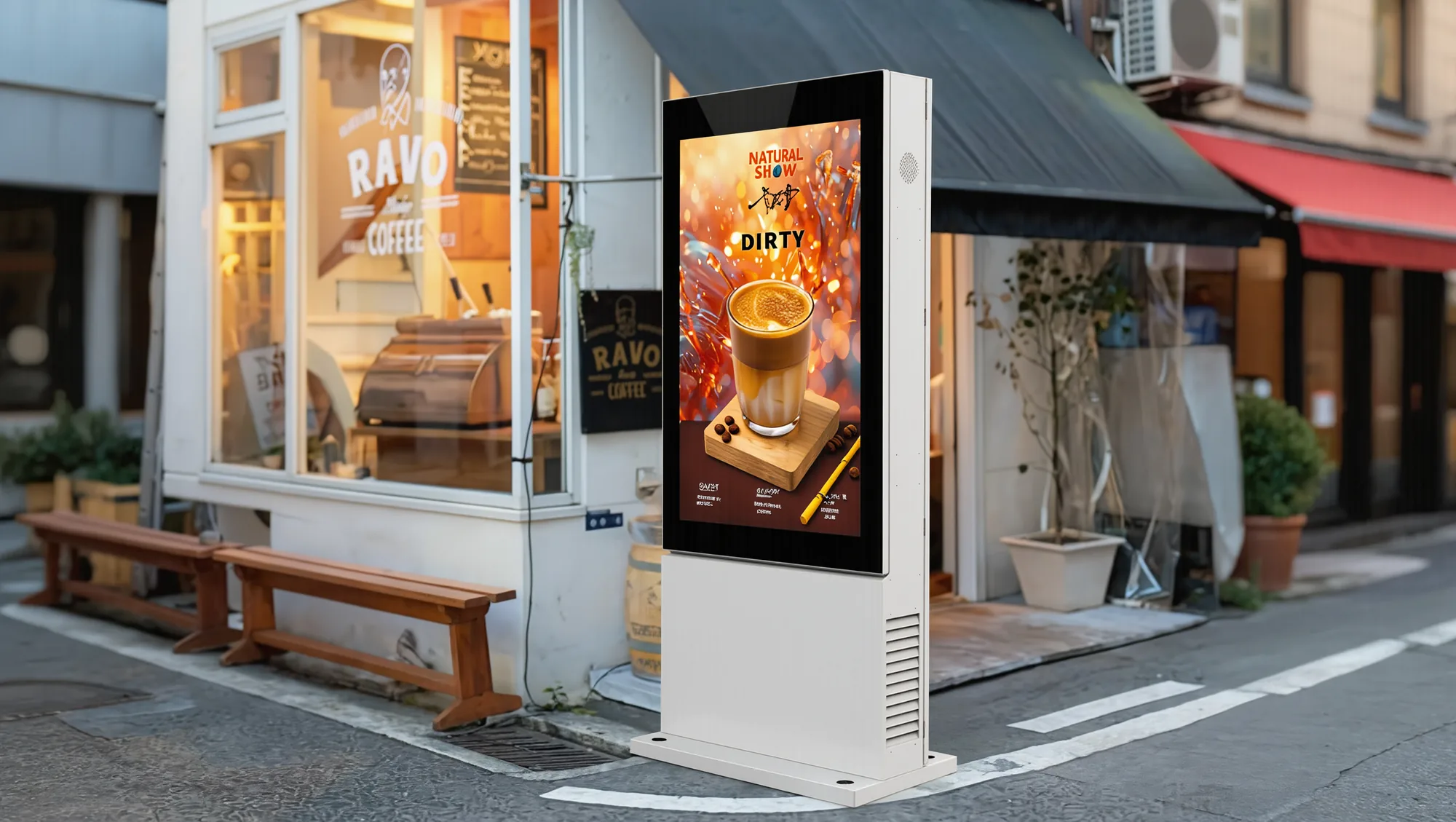
Typical outdoor deployments
Outdoor signage fails when the enclosure and cooling are sized for a different climate than the site actually sees. The programmes below share one factory and one set of panel options; what changes is facing, IP package and thermal design.
| Street and plaza totems | Freestanding high-brightness units with front or rear service access, IP-rated enclosures and weighted bases for advertising and wayfinding on pavements and squares. |
| Campus and transit hubs | Wall-mounted or freestanding information boards where sun load through open plazas and rain drive the thermal and gasket choices. Overlaps with Transit when the unit sits on a platform edge. |
| Retail facades | Double-sided or wall-mounted programmes facing east/west solar load. Heat-exchanger or air-conditioned packages as required; anti-reflective glass so midday content stays readable. |
| Industrial yards and gates | Dust- and water-sealed builds for weighbridges, gate instructions and safety boards. Tell us the climate band and facing so we recommend one thermal design rather than quoting all three. |
| Semi-outdoor lobbies | Glazed atriums and open-sided canopies often need outdoor brightness and cooling even when the floor plan says “indoors”. If direct sun hits the screen for hours, treat it as outdoor. |
Enclosure types and thermal design
Three enclosure families cover most projects: freestanding totems, wall-mounted cabinets and double-sided units. Panel sizes typically run 32″–98″. The decision that actually decides lifetime is how the box is cooled under the worst sun load for that facing and latitude.
| Freestanding | Plaza and pavement totems; cable routed through the base; service doors for filter and module access without unmounting the screen. |
| Wall-mounted | Facades and campus walls; shallow depth where possible; confirm structural capacity and cable path before locking the SKU. |
| Double-sided | Street furniture and campus paths where both approaches must see content. Thermal load roughly doubles — cooling must be sized for both faces. |
| Heat-exchanger packages | Closed-loop cooling that keeps dust and rain out of the electronics bay. Common for dusty or coastal sites. |
| Air-conditioned packages | Higher ambient or dark-cabinet / west-facing loads where exchanger capacity is not enough. Higher power draw; say so in the site power plan. |
| Brightness | Outdoor LCD programmes typically need high-brightness panels so content holds under direct sun; exact cd/m² tiers and LED options are on the outdoor product page. |
Protection is itemised on the product page — IP rating, tempered glass, filters, surge and temperature cut-outs. Application buyers should send facing (N/S/E/W), latitude or city, and whether the unit sits in full sun or under a canopy; that is enough for us to recommend one thermal design.
Why facing and climate come first
Two identical 55″ freestanding totems can need different cooling if one faces north under a canopy and the other faces west in open sun. Panel brightness, glass, filters and thermal package are sized from that site reality. Sending only “outdoor 55 inch” forces us to either over-spec (and over-price) or under-spec (and risk field failure). City or latitude, facing, and canopy yes/no are enough to pick a sensible package on the first quote.
Service access is part of the enclosure design. Filters, fans and modules need to be reachable without lifting a tonne of steel off a pavement footing. Freestanding units get front or rear doors sized for that; wall units need a clear service envelope on the drawing. If your maintenance team will work from a lift truck, say so — door swing and connector placement change.
LCD covers most advertising and wayfinding at typical street distances. LED modules enter when the viewing distance is long, the creative needs extreme brightness, or the architecture calls for a fine-pitch video wall rather than a framed LCD. Those programmes are quoted from the LED section of the outdoor catalogue; the application questions (facing, power, CMS boundary) stay the same.
Certification and warranty terms depend on destination market and the exact configuration. Tell us the country early so the documentation pack — and any local mark route — is planned with the hardware, not chased after the container has sailed. Warranty coverage assumptions for outdoor duty (filters, glass, thermal modules) are spelled out on the product page so distributors can set end-customer expectations without ambiguity.
What to specify
- Screen size (32″–98″) and whether freestanding, wall-mounted or double-sided
- Installation country / city, unit facing, full sun vs canopy, and expected ambient extremes
- Quantity, single-sided vs double-sided, and whether LED is preferred over LCD for the viewing distance
- Brand colour, logo placement and packaging requirements
- Power available on site and any local certification path you must hit
Full brightness, IP, thermal and certification tables live on the outdoor product page, including freestanding, wall-mounted and double-sided detail pages. MOQ, lead time and enquiry checklist are there as well.
OEM boundary — factory vs turnkey
The same division as our other application lines: we manufacture and ship the outdoor terminal. CMS software, content, foundations, power drops and on-site installation remain yours or your integrator’s. That is what lets us quote non-standard enclosures and modest MOQs that a turnkey media-owner will not take on.
| We supply | Enclosure, thermal package, panel, board image as specified, harness, brand artwork, export packing and market documentation you request. |
| You supply | CMS / media player software (unless you buy a unit with a specified player image), creative, site survey, concrete and cabling, permits, and commissioning. |
| Related lines | Platform-edge passenger boards may fit better under Transit. Pure indoor lobby boards belong on Indoor — do not pay for outdoor cooling you will not use. |
Delivery details — climate, mounting and transport
B2B outdoor programmes fail on delivery assumptions as often as on brightness. The figures below are the ones we publish on the outdoor product pages; site-specific wind and height packs are quoted per project — not invented as a single generic class.
- Ingress & climate: IP6X dust and IPX5 water on the outdoor enclosure programmes; laminated anti-glare glass; panel rated −20 °C to +68 °C. Three thermal designs — pick by city, facing and full sun vs canopy.
- Brightness: 3,000 / 5,000 peak nits across LCD and LED outdoor builds (32″–98″).
- Mounting: freestanding (weighted base), wall-mounted or double-sided. Mounting height and wind-load rating are specified per site wind zone, enclosure mass and foundation — send city, facing and preferred height with the RFQ; we return the structural / fixings pack with the quote rather than a one-line wind class.
- Transport & loading: enclosures ship in project packaging sized to the cabinet (crate or pallet as quoted). Confirm loading gauge, lift points and on-site access with the order pack before the unit leaves the line.
Full IP, thermal and certification tables: Outdoor Displays. Facing and climate rationale are earlier on this page.
Plan an outdoor programme
Send size, quantity, country and facing. Feasibility, recommended thermal design, MOQ and tiered pricing within one business day.