
Applications
Elevator and building displays
Six terminal formats for lift cars, lobbies and building management rooms — portrait, landscape, dual-screen, triple-screen, and a video wall for the control room. Built for a screen that is switched on continuously in a confined, vibrating enclosure and reached only by a technician.
We supply the terminals. The advertising network, the content management platform and the lift-controller integration are yours — though the units accept a standard content push and can be driven by whatever CMS you already run.

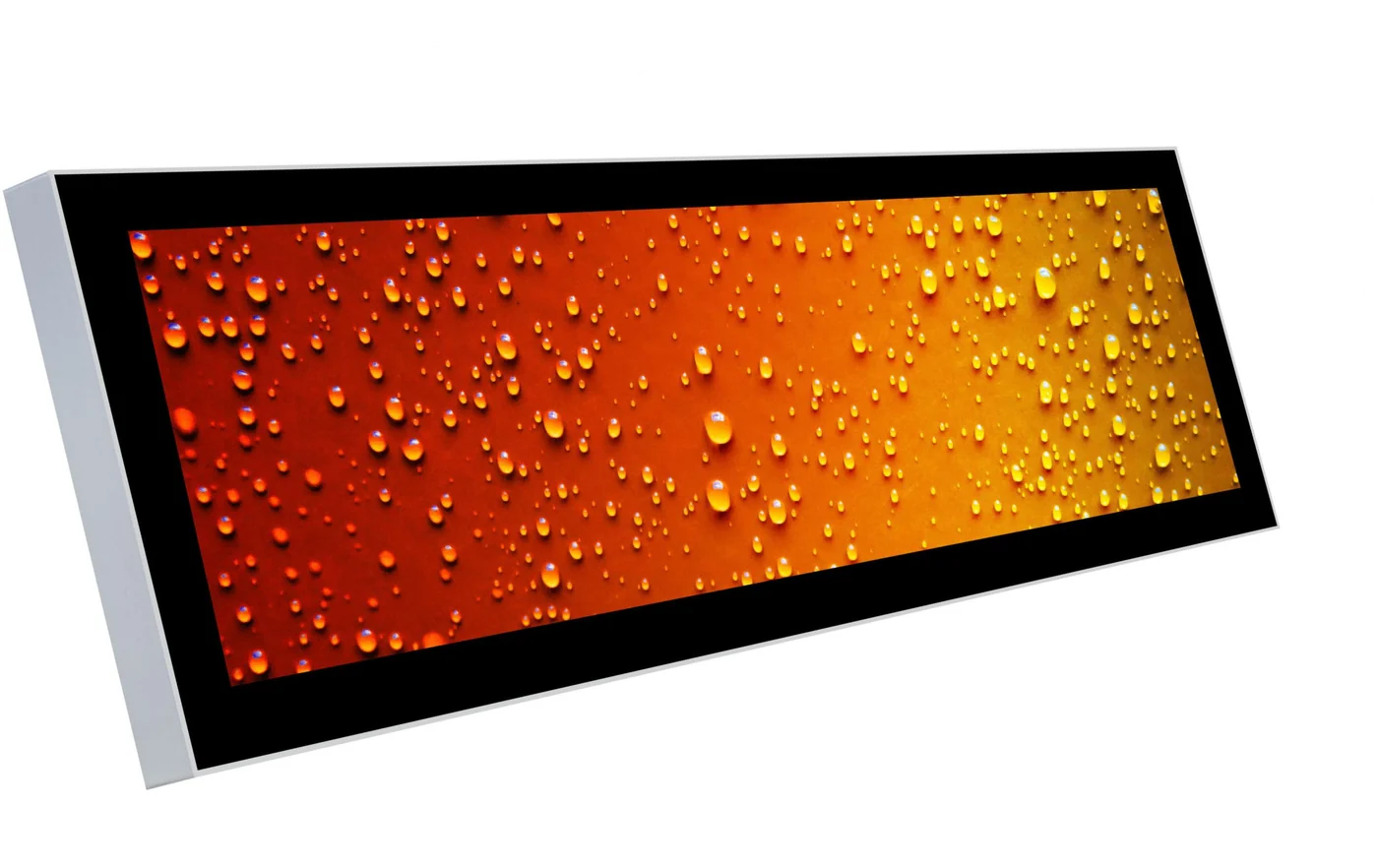
Six formats
The multi-screen formats exist for a specific reason: a single screen has to choose between advertising revenue and building information, and the operator loses either way. Splitting them across a main panel and one or two auxiliary strips lets the floor indicator, notices and emergency messages hold their own space permanently while the main panel runs commercial content.
| Format | Screens | Board | Typical use |
|---|---|---|---|
| Portrait | 18.5″ / 21.5″ / 24″ | Allwinner A40i or RK3288 | Standard car-wall installation |
| Landscape | 18.5″ / 21.5″ / 24″ / 32″ | Allwinner A40i or RK3288 | Above-door or wide car installation |
| Dual, compact | 18.5″–24″ plus 10.1″–12.8″ | Allwinner A40i or RK3288 | Content panel plus floor and notice strip |
| Dual, large | 27″ / 32″ plus 24″ / 28″ | Allwinner A40i or RK3288 | Lobby and high-traffic cars |
| Triple | 21.5″–24″ plus two 10.1″–11.6″ | Rockchip RK3568 | Content, floor indicator and notices separated |
| Control room | 49″ / 55″ / 65″ video wall | Rockchip RK3568 | Building management and lift monitoring |
Shared specification
| Panel | IPS, 178° viewing angle |
| Resolution | 1366 × 768 or 1920 × 1080; 4K on the control-room wall |
| Brightness | 200–250 cd/m²; 250–300 cd/m² on triple and control-room units |
| Contrast ratio | 1200:1 |
| Colour depth | 1.07 billion (8-bit + Hi-FRC) |
| Backlight life | 60,000 hours |
| Memory / storage | 1 GB + 8 GB, 1 GB + 16 GB or 2 GB + 16 GB |
| Ports | 2 × USB, RJ45, TF card slot |
| Display modes | Full screen, split screen, portrait or landscape |
| Audio | 3 W / 8 Ω speaker |
| Control | Infrared remote receiver plus header pins for a wired receiver |
| Finish | Standard white or black; custom to specification |
Note the brightness figure. A lift car is an enclosed, evenly lit space — 200–250 cd/m² is the correct specification there, and a brighter panel would only be glare in a passenger’s face at arm’s length. Outdoor-grade brightness belongs on the shelter and roadside units, not here.
Building management video wall
The other end of the same deployment. Lift car terminals report status; someone has to watch it. The control-room wall comes at 49″, 55″ or 65″ with a choice of 3.0 mm, 1.8 mm, 0.88 mm or seamless join, driven by an RK3568 with split-screen support so several feeds sit on one array.
For larger control rooms, or where the wall is the primary monitoring surface rather than an adjunct, the dedicated video wall range covers 0.88 mm LCD arrays and COB fine-pitch LED with the higher brightness and contrast that continuous monitoring work needs.
Why this is a manufacturing problem
An elevator display is one of the least accessible screens anyone deploys. It runs every hour the building is occupied, it lives with the vibration and door-slam shock of a lift car, and replacing one means taking the car out of service. The economics of the installation assume it will not need attention — which puts the whole burden on how the unit was built.
| Ageing | Automated in-line burn-in on the production line; every unit runs before it ships |
| Module assembly | Two LCD module lines in a cleanroom with ultra-clean areas |
| Environmental test | High and low temperature humidity chambers, mechanical strength rigs, high-temperature ageing room |
| Certification | ISO 9001 quality system; IP-rights management system certification; CCC on relevant products |
| Status | National High-Tech Enterprise and Tianjin High-Tech Enterprise |
Certification for your market is a separate exercise — CCC covers China. Tell us the destination and we will confirm what we can supply and what has to be tested.
What we change per order
- Screen combination and orientation, matched to the car interior you are fitting
- Bezel profile, colour and finish, so the unit reads as part of the car rather than an addition
- Mounting interface — surface, recessed or replacing an existing panel
- Mains voltage and plug type for the destination market
- Board choice, where a heavier content mix needs the RK3568 rather than the A40i
- Boot logo, default content and power-on behaviour
The full OEM and ODM process covers how a non-standard build runs from drawing to delivery. Related deployments: public-sector terminals and healthcare terminals run on the same platform families.
Specify an elevator terminal
Tell us the car dimensions, the screen combination and the market it ships to. Feasibility, indicative MOQ and tiered pricing come back within one business day.