
Products · LED holographic invisible screen
LED holographic invisible screen
A frameless transparent LED film, under 3 mm, on a PCB with a hollow mesh circuit. It mounts on glass, and it can be bent and cut. Three pitches: P2.5, P3.91 and P6.25.
Product family on this page: holographic film LED (frameless transparent film on a hollow-mesh PCB) — labelled by pitch as P2.5 / P3.91 / P6.25. The EN catalogue does not list separate Regular cabinet, Flex strip or Film-only SKUs as stand-alone families; transmittance % and brightness below are per pitch model.
The film on a working glass wall
Shot at an installation. The film is applied to the inside of an office glass partition and left running. The room behind the glass stays readable through the mesh, which is what the hollow PCB buys you.
What the film is
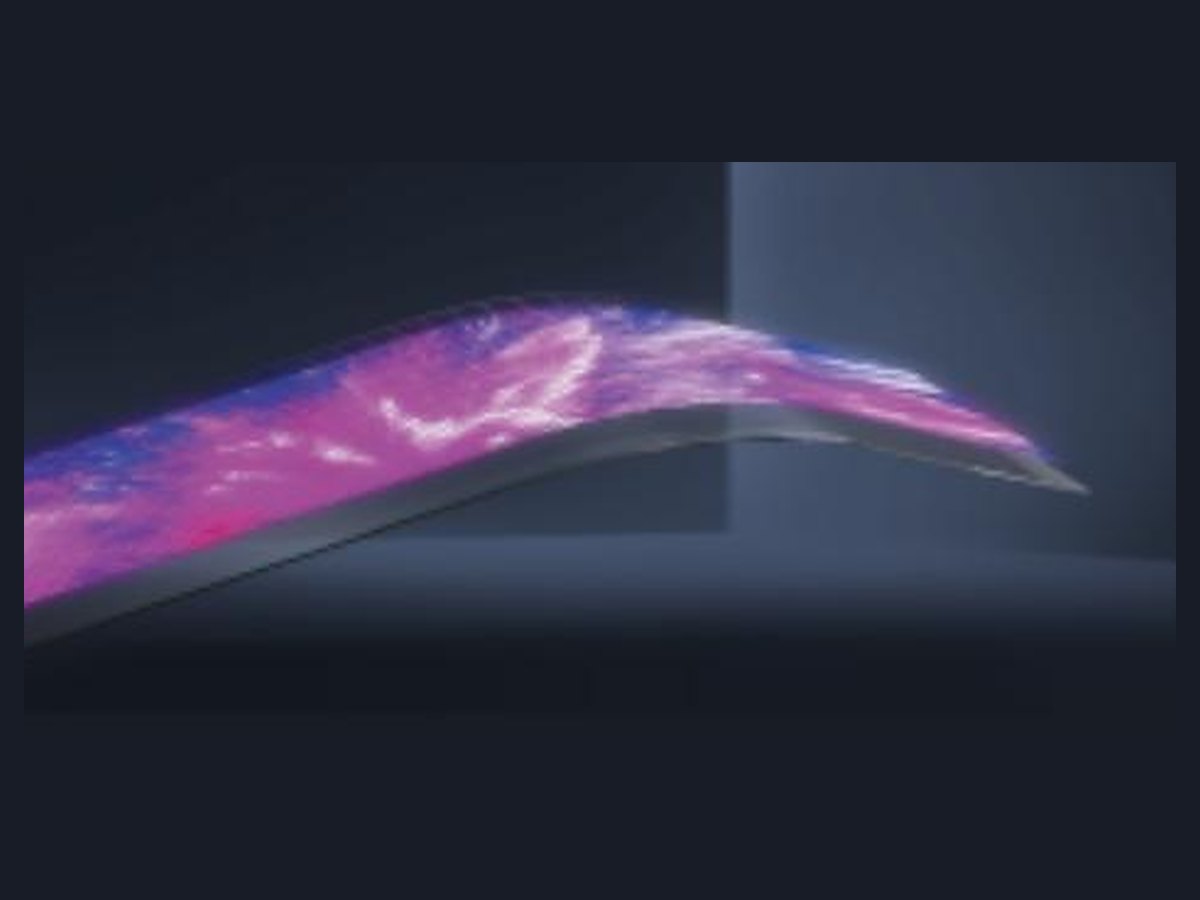
The catalogue describes a frameless lamp board. The PCB carries a hollow mesh, so the glass behind the film stays visible. Thickness is under 3 mm. The same page says the driver chips are developed in-house. The film is specified for flat glass and for curved or irregular glass.
The introduction says transmittance for the series can reach over 80%. The parameter table prints 70% on P2.5, 82% on P3.91 and 92% on P6.25. We quote the table. A feature card says the minimum weight is 1.2 kg. That figure is the P6.25 module. P3.91 is 1.5 kg and P2.5 is 1.63 kg, per module.
Three models
Power is per square metre, weight is per module. Brightness on every model is printed as adjustable. Brightness and size are also printed as customizable to the order.
| Model | Pitch | Module resolution | Points/m² | Transmittance % | Brightness (catalogue) | Module weight | Peak / average |
|---|---|---|---|---|---|---|---|
| P2.5 | 2.5 × 2.5 mm | 50 × 400 px | 160,000 | 70% | ≥1,200 cd/m² | 1.63 kg | 800 / 300 W/m² |
| P3.91 | 3.91 × 3.91 mm | 64 × 307 px | 65,536 | 82% | ≥3,000 cd/m² | 1.5 kg | 1,000 / 380 W/m² |
| P6.25 | 6.25 × 6.25 mm | 40 × 192 px | 25,600 | 92% | ≥5,000 cd/m² | 1.2 kg | 1,000 / 380 W/m² |
The solutions page prints one module size for the series, 1230 × 250 mm. The module resolutions do not multiply out to that size. P6.25 at 40 × 192 px is 250 × 1,200 mm. P3.91 at 64 × 307 px is about 250 × 1,200 mm. P2.5 at 50 × 400 px is 125 × 1,000 mm, while 160,000 points/m² does match a 2.5 mm pitch. We confirm the module drawing for the pitch you order before quoting.
Project quote check (P6.25 film, 2026-09-23): white-balance brightness 2000 cd/m², screen transparency >65%, inter-module seam <0.1 mm, ingress better than IP45, module size on that quote 1400 × 250 mm, weight <3.5 kg/m². Catalogue peak brightness / transmittance in the table above are the printed series figures; we confirm white-balance brightness, transparency and module drawing for the pitch you order before locking a quote.
Ratings shared by all three models
| Item | Rating |
|---|---|
| Colour temperature | 2,000 K to 9,500 K, adjustable |
| Operating range | −10 °C to 60 °C, 10% to 90% RH, no condensation |
| Pixel | 1R1G1B |
| Viewing angle | 120° horizontal, 110° vertical |
| Evenness | ≥98% |
| Contrast | 4,000:1 |
| Ingress | IP43 |
| Refresh | ≥3,840 Hz |
| LED life | ≥100,000 hours |
LED life is printed on the parameter table as “≥10Ten thousand hours”, which is 100,000 hours. IP43 is the rating on the film, for glass indoors and under cover. Outdoor enclosures are specified on the outdoor displays page. Cabinet LED and LCD video walls are on the video walls page.
On the floor
Powered up and running before it is packed
Two modules on the shop floor, running a test image before they are crated. The same plant builds the rest of the range; the site tour on the about page walks it building by building.
How a module builds into a screen
Modules dock up and down, and the run extends to either side. The catalogue prints that arrangement as the way a window or a curtain wall is filled. Send the glass width, the glass height and the pitch, and the quote comes back with the module count for that opening.
Where the catalogue specifies it
| Place | Named use |
|---|---|
| Shop window | Product display and short-run promotion on the glass |
| Airport lobby | Flight information, and a map of the terminal |
| Auto showroom | Vehicle display on the glass. The catalogue also names a product configurator. We supply the screen. The software stays with you. |
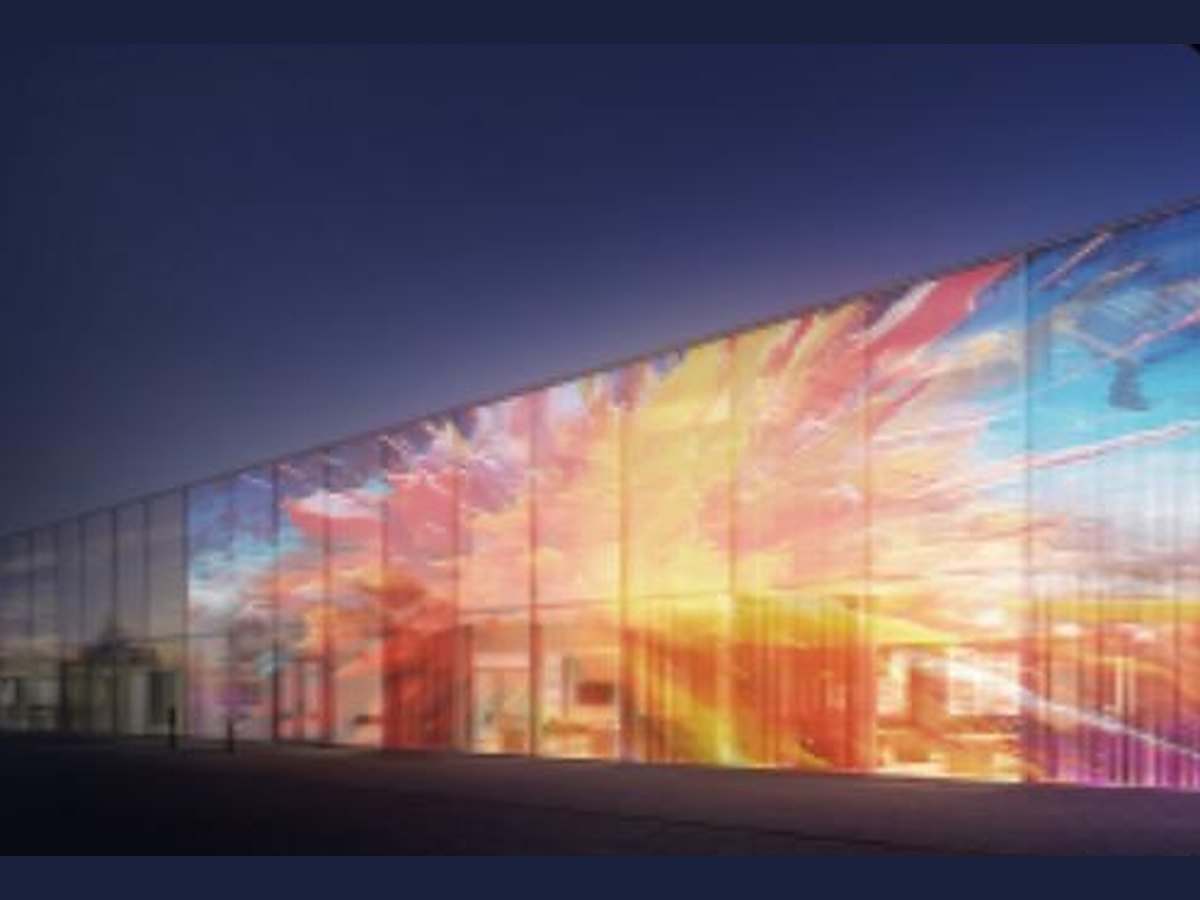
| Curtain wall | Advertising, identity and time on the facade, and the same film on interior glass |
| Malls and storefronts | Creative displays, exhibition glass and retail frontage |
From the module to the facade
A factory reel that follows the film itself: the module unrolled, mounted on its lamp board and bent to a curve, then the same film running across a glass facade and up a tower. Rendered by the plant, not filmed on site.
Specify a holographic screen
Tell us the pitch, the glass size, and whether the glass is flat or curved. You get the confirmed module count, the certification set for your market, MOQ, tiered pricing and a lead time within one business day.