
Products · Outdoor displays
Outdoor High-Brightness Displays, 32″ to 98″
Freestanding, wall-mounted and double-sided enclosures built for permanent outdoor installation. IP6X dust, IPX5 water, laminated anti-glare glass and a choice of three thermal designs. We publish the temperature data, not just the IP rating.
Three enclosure types
Start with how the unit is installed. The panel, the glass and the thermal options are shared across all three; the enclosure and the size range are what differ.
| Enclosure | Sizes | Orientation | Typical use |
|---|---|---|---|
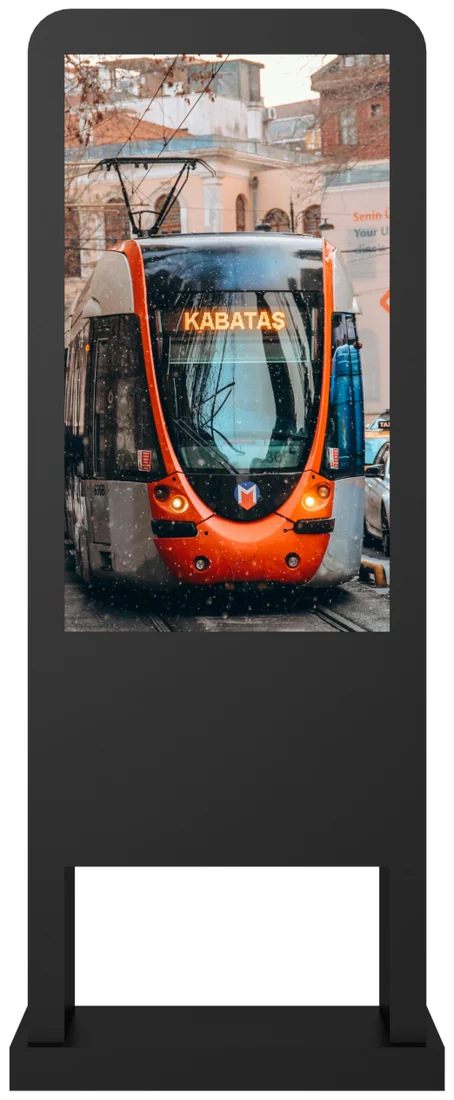
| Freestanding | 49″ – 98″ | Portrait or landscape | Streetscape, plaza, forecourt, EV charging bay |
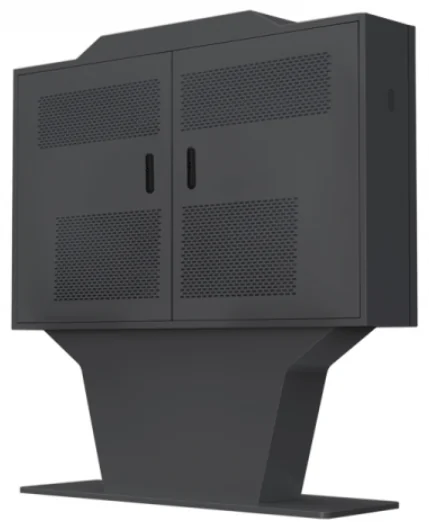
| Double-sided | 49″ / 55″ / 65″ | Portrait, back-to-back | Pedestrian streets, transit interchanges, island sites |
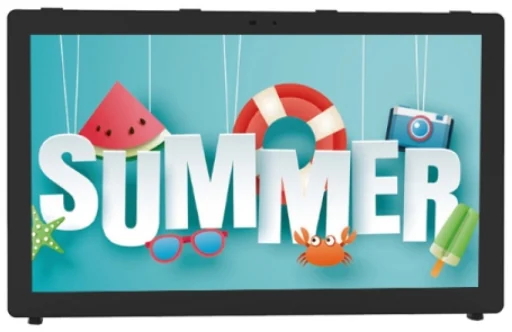
| Wall-mounted | 32″ – 98″ | Portrait or landscape | Building façades, drive-thru lanes, station platforms |
The decision that matters: how the box is cooled
An outdoor display does not fail because of the panel. It fails because the enclosure could not get heat out of it in July, or because the filter was never changed. Three thermal designs are mature enough to specify, and they are not interchangeable — each one buys something and costs something.
| Forced-air cooling | Heat exchanger | Air conditioning | |
|---|---|---|---|
| How it works | EMB centrifugal fans drawing through an F7 filter | Axial fans over a sealed heat-exchange core | Industrial air-conditioning unit inside the enclosure |
| Ambient range | −30 °C to +45 °C | −30 °C to +40 °C | −30 °C to +50 °C |
| Ingress rating | IP6X dust, IPX5 water | IP65 | IP65 |
| Cost and power | Lowest of the three | Middle | Highest, and the running cost stays high |
| Enclosure depth | Slimmest | Slim | Deepest |
| Noise | Comparatively quiet | Loud | Loud — around 70 dB |
| Maintenance | Filter has to be cleaned or replaced on a schedule | Sealed — no filter service | Compressor service |
| Where it is wrong | Desert and extreme-heat sites | Anything outside −30 to +40 °C | Noise-sensitive sites; tight budgets |
BEFORE WE CAN QUOTEIf you only tell us the screen size, we will ask two more questions before quoting: where the units are going, and which way they face. Those two answers change the thermal design, and changing it after tooling is not a small revision.
What the panel actually runs at
These are measured panel temperatures across a full year at one Chinese city, for each thermal design and each facing. Two things drive the number: how much the enclosure adds over ambient, and how much the sun adds on top when it hits the glass directly. East- and west-facing units take the full solar load; north- and south-facing units take about half of it.
| Thermal design | Facing | Enclosure rise | Solar rise | Panel, summer | Panel, winter |
|---|---|---|---|---|---|
| Heat exchanger | East / west | 24.0 °C | 9.5 °C | 60.5 °C | 30.0 °C |
| North / south | 24.0 °C | 5.0 °C | 56.0 °C | 25.5 °C | |
| Forced air | East / west | 15.0 °C | 9.5 °C | 51.5 °C | 21.0 °C |
| North / south | 15.0 °C | 5.0 °C | 48.0 °C | 16.5 °C | |
| Air conditioning | East / west | Decoupled from ambient | Held below 49.5 °C year-round | ||
| North / south | Decoupled from ambient | Held below 45 °C year-round | |||
READ THIS CAREFULLYRead the first two rows carefully. Facing east or west, the heat-exchanger and forced-air designs run the panel above 50 °C for roughly three months of the year. That is inside the panel’s rated −20 °C to +68 °C window, so it is not a fault — but it is why an air-conditioned enclosure exists, and why we ask which way the units face before quoting one.
How we know
Solar radiation chamber, then a real installation. In the chamber the ambient is driven to 60 °C with simulated solar load on the glass, and readings are only taken once every temperature and humidity point has held for more than an hour — an outdoor enclosure needs that long before its interior settles, and data taken before it does is meaningless.
- Direct-airflow design, on site: panel ran at most 15.8 °C above ambient, with no direct sun on the glass
- Air-conditioned design, on site: panel temperature did not track ambient at all — held below 40 °C, peak 39.5 °C
- Panel rating: −20 °C to +68 °C operating, which is what makes the first two designs viable in most of the world
A working reference for the hard end of the range: a mixed installation in Ordos, Inner Mongolia — two 47″ 2×2 arrays, a 2×3 array and a 72″ single unit. Ambient runs from −20 °C to +35 °C and the site gets roughly two months of sandstorms a year. Dust sealing and airflow were simulated before build and verified after.
Protection, item by item
| Glass | Laminated anti-glare front glass, 4+4 construction, imported. Blocks enough direct sun for the image to hold up in full daylight |
| Impact | 1 kg steel ball drop test on the 4+4 laminate: intact at 1.2 m, fractures at 1.3 m. Thickness is selected per screen area and mounting method |
| Water | IPX5 — continues operating in heavy rain |
| Dust | IP6X. Multi-stage: anti-static dust materials, G3 filter media, and a breathable membrane sized against the airflow the enclosure needs |
| Lightning | Surge-protected mains entry with an earthing bar, so the unit stays safe through a storm rather than being switched off before one |
| Anti-theft | No fastener is exposed on any visible face. Concealed fixings, security locks and a rigid structural frame, benchmarked against the Chinese national Class A / Class B forced-entry standards |
| Noise | Structural damping plus intelligent fan control, referenced to the Chinese urban environmental noise classes — the limit is 50 dB day / 40 dB night in the quietest class, which is what rules out air conditioning on some sites |
| Brightness | Ambient light sensor drives automatic brightness. Keeps the screen readable, cuts power draw and avoids light pollution complaints at night |
Inside the enclosure
Four modules behind the service door, so a field fault is a module swap rather than a unit replacement: the AC control module (thermal cut-out, surge protection, earthing bar, warning labels), the power module (separate switching supplies for panel and fans, plus fan control), the function module (media player board, driver board, amplifier board), and the fan assembly with its ducting and filter media.
DECIDE BEFORE TOOLINGIf your installer is not ours, say so at quotation. We will specify which module the field engineer is expected to reach and lay the interior out accordingly — that is a cheap decision before tooling and an expensive one afterwards. The same applies to our transit displays and custom enclosures.
Specify an outdoor display programme
Tell us the screen size, the quantity, the installation country and which way the units will face. You get a full specification sheet with the recommended thermal design, MOQ, tiered pricing and a lead time within one business day.